|
| The Oak Ridge 13 who were arrested and imprisoned on July 5, 2010 for crossing into the Y-12 National Security Complex in Oak Ridge, Tenn., “birthplace” of the atom bomb. |
Let every nation know, whether it wishes us well or ill, that we shall pay any price, bear any burden, meet any hardship, support any friend, oppose any foe, in order to assure the survival and the success of liberty.
John F. Kennedy, Inaugural Speech, 1961
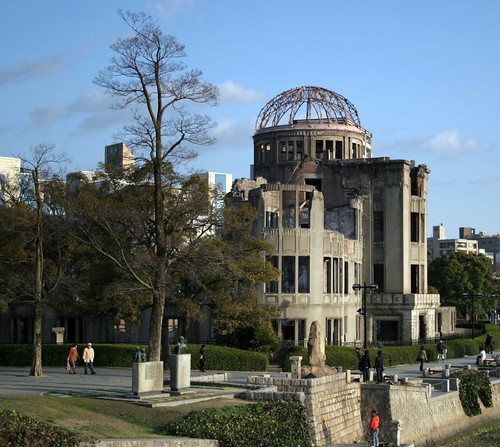
Sixty-six years ago today, the United States dropped the atom bomb on Hiroshima and killed 90,000 to166,000 Japanese, most of them civilians. Three days later it dropped another bomb on Nagasaki and killed 60,000 to 80,000 more.
As the Cold War progressed and people obsessed over the threat of nuclear destruction, John F. Kennedy, a new president from a new generation, took command of one of the two most powerful nations in the world and promised to secure our country no matter what it took to do it. He began the Intercontinental Ballistic Missiles (ICBM) program where 1,000 missiles were planted in silos right in the heart of the country: the Dakotas, Kansas, Missouri, Colorado, Wyoming. The power of each missile was 1,000 times more than the bombs dropped on Hiroshima and Nagasaki.
Each silo is covered by a 20-ton concrete lid that was designed to protect the missile below from being a target. If you are out on the plains and see these missile sites, it's difficult to recognize them for what they are. If anything, they look like electric substations. Two operators are assigned to ten missile silos. If given the order by the president, they would each simultaneously throw a switch to launch them.
The existence of these lethal weapons, some of which are on “hair-trigger alert” (they can be deployed within 15 minutes of the president’s order) present a potentially scary scenario of pre-emptive strike and retaliation that would surely end the world as we know it.
Another unfortunate consequence is that the “Nuclear Club” has been expanded to nine nations and made the world more vulnerable to nuclear attack, especially when “rogue nations” like North Korea acquired “the bomb” and Iraq and Iran are said to be working on it.
Then there is the cost factor.
This figure was largely unknown until 2000 when Stephen I. Schwartz published a two-year research project titled
Atomic Audit: The Costs and Consequences of U.S. Nuclear Weapons Since 1940 (Brookings Institution Press, 1998). At the time he was a guest scholar at the Brookings Institution and director of the U.S. Nuclear Weapons Cost Study Project.
His paper was one of the first of its kind to determine what the nation had spent on nuclear weapons, which at the time turned out to be $4 trillion.
When the Soviet Union collapsed in 1991, there was a tremendous sigh of relief that the threat of nuclear war was gone, said Hutchison, so Americans stopped thinking about it and the issue disappeared from the public’s imagination. However, the danger of someone using a nuclear weapon is greater now than it was during the Cold War due to a lack of vigilance in making sure nuclear materials are kept secure.
“It won’t be an exchange between the United States and Russia,” said Hutchison. “Non-state actors have potential access to nuclear materials for crude or dirty bombs. Proliferation has occurred because Pakistan has given information to other countries to pursue their capabilities.”

So it is no wonder that some peace activists have made the manufacturing, updating and stockpiling of nuclear weapons an issue for public attention. They are even willing to go to jail for the cause of ridding the world of this dangerously lethal and expensive hardware—like the 200 activists who conducted a demonstration last year at the Y-12 National Security Complex in Oak Ridge, Tenn., “birthplace” of the atom bomb.
Today, Y-12 manufactures and refurbishes new parts for old nuclear warheads and it was set to receive $7.5 billion in new funds for a new bomb plant, infrastructure and equipment and close to $1 billion for refurbishment.
Thirteen of the activists were arrested on federal trespassing charges after they crawled under a barbed wire fence to reach an area that was posted as off-limits.
Jean Gump, 84, of Kalamazoo, Mich., was among the seven women, four of whom were nuns, and six men, one of whom was a priest.
Another 23 activists faced state charges for brief obstruction of a road into the plant. Joe Gump, 83, Jean’s spouse, was among them.
The Gumps spoke about their experience at a recent gathering of peace activists held at the Friends Meeting House in Kalamazoo, Mich.
Y-12 Protest of July 5, 2010
 |
| The supporters block the entrance of the Y-12 complex and are arrested by state and county law enforcement officials |
The peace activists used the July 4 weekend for a three-day “Celebration of Resistance to recognize the 30
th anniversary of
Nuclear Resisters and
Nuke Watch, which have supported imprisoned anti-war/ anti-nuclear activists and informed the public about nuclear weapons, respectively.
Plowshares was also honored for its 30 years of nuclear disarmament advocacy that began on Sept. 9, 1980, when Daniel and Philip Berrigan and six others entered a General Electric missile facility at King of Prussia, Pa. and "damaged" a warhead nose cone and placed blood on documents at the plant.
Since then, members of Plowshares have been in more than 100 nuclear resistance actions, including the October 2002 break-in at the N-8 Minuteman Missile silo in Colorado by three nuns: Ardeth Platt, Jackie Hudson, Carol Gilbert. The nuns, whose civil disobedience was featured in the film, Conviction, were also present at the Y-12 protest and among the 13 who were arrested.
The Gumps have participated in a Plowshare disarmament action, Jean in 1986 and Joe in 1987, and they both served time in federal prison for it.
Plowshares’ actions are derived from the Old Testament Book of Isaiah 2:4
“God will judge between the nations and will settle disputes for many people. And they shall beat their swords into plowshares and their spears into pruning hooks. And nations will not take up swords against nations, nor will they train for war anymore.”
Organizers wanted to hold the celebration near a nuclear weapons plant, so Oak Ridge was chosen and OREPA was also invited to host the event.
The group attended OREPA’s Sunday evening vigil that has been held at Y-12 every week for the past 15 years.
After the activists conducted an hour-long service of prayer, singing, and speeches, they went to the Y-12 entrance where they were met by 60-70 officers of the Oak Ridge Police, Tennessee Highway Patrol, Anderson County Sheriff’s Department, Wackenhut private security officers and possibly some federal marshals.
“We’ve never had any kind of incident or problem,” said Hutchison. “We were a very well behaved crowd, which was acknowledge in testimony at the trial. Three police officers could have completely taken care of any security needs.”
Jean said that it is typical to see this many layers of law enforcement at anti-nuclear weapons demonstrations.
“The police were watching us all the time,” she said. “They waved and were friendly—until the action.”
Then the police arrested the protesters and placed them in plastic handcuffs. Each officer was assigned a protester and all were treated with real “Southern hospitality,” said Jean.
“They’re doing a job and that’s what they have to do,” she said.
The Trial
On May 9-11, 2011, the thirteen activists went to trial with Federal Magistrate Bruce Guyton presiding on a misdemeanor charge of trespassing, which had occurred on July 5, 2010.
Their motion to dismiss all charges against them having been denied, they mounted a defense that challenged U.S. nuclear weapons policy and the government’s plans for a new bomb plant in Tennessee, according to an
OREPA report.
Before trial, Jeff Theodore, federal prosecutor and Melissa Millican, assistant district attorney, had successfully filed an
in limine motion that prevented the defendants from using 12 specific defenses. These defenses included the defendants’ moral or religious basis for their action, violation of U.S. treaties regarding nuclear weapons and international law.
In fact, they were unable to present
any evidence to justify their action; the verdict was to be decided on whether or not they trespassed by crossing into Y-12 federal territory. A unanimous jury found them guilty after deliberating 45 minutes.
As Joe observed, "Our legal system has truly become a criminal justice system.”
After being found guilty, the thirteen were released on personal recognizance, but some decided to begin their likely prison time and were put in jail. All had been on probation for most of the past year having to report to and not being able to leave their states without permission from their probation officers. Such probation is usually served after having been found guilty at trial and completing a prison sentence, not before being tried and found guilty.
Jean was initially sent to jail in Marysville, Tenn. and then moved 400 miles to a federally financed private jail in Ocilla, Ga. After one month, she decided to go out and serve whatever prison time she would receive after sentencing, which is scheduled for September 12, 2011.
“Who would ever dream that walking across the line would give us the kind of punishment we got,” said Jean.
Actually the activists had little doubt that the jury would find them guilty, given the narrow parameters of the trial.
“Besides, half of the people who live in the area work at Y-12, or have family who work there,” said Jean. “If they closed down the plant, too many people would be out of work.”
This economic issue has been and continues to be a
conundrum for the community that was built as “the secret city” during World War II. It also extends to their attitudes about the health of the community, which has been compromised.
 |
| One of the cancer victims of Y-12 who volunteers at the American Museum of Science and Energy in Oak Ridge |
For example, the
May 11, 1992 issue of Time featured a peculiar story about the area’s contamination that has resulted from the heavy metals used in nuclear weapons production. Most workers contract some kind of cancer and residents are warned against eating fish and deer from the area because it is undoubtedly contaminated by the plant’s emissions. Yet, residents willingly live under these conditions because they have good jobs.
Reflections on the Action
This September, Jean and the other protesters will return to the federal courthouse in Knoxville for sentencing. Potentially, they could each receive a $100,000 fine and one year in prison for trespassing an off-limits federal area. Joe believes, however, the magistrate will rule “time served” and Jean will be able to go home and carry on with her life.
Over the past year, Jean is very reflective about her civil disobedience and the motives behind it.
 |
| Jean and Joe Gump |
“Periodically, I put myself on the line for what I believe in,” said Jean. “Killing people with weapons of mass destruction is inappropriate, so I feel I want to be on the front line of resistance.”
“I’m a person of faith,” she continued. “Christianity is about love and serving Jesus and one another and so I must continue to fight against the injustice of nuclear weapons because if they were used, so many people could be obliterated by them.”
The Gumps have been devout Catholics throughout most of their lives, but they are also very political people. After 9/11 they became so disgusted at seeing all the American flags displayed in churches, they stopped attending Mass and instead pray together daily.
It is difficult to get churches involved in peace activism, said Joe, who quoted Fr. Daniel Berrigan about pastors having to be “fence sitters” favoring government and being against it at the same time, otherwise they will alienate too many people in their parishes.
“Fr. Berrigan (who died last year at 89) used to say that he could not not resist when he saw injustice or he’d be inconsistent with his religious beliefs,” said Joe. “That’s how it is for me, too. If we all behaved on that basis, we could all have a small piece of the action.”
However, both Joe and Jean are quick to point out that jail isn’t for everyone. Instead, they say that each person must “be peaceful with him/herself” and “do what s/he can for the cause of justice.”
The build up of nuclear weapons all started in 1946 with President Truman’s National Security State, said Joe, where he devoted our wealth and resources to protect us from our enemies, which over the years has included the Soviet Union (Russia), China, Vietnam communists, Grenada and most recently, the Axis of Evil: Iraq, Iran and North Korea.
“We have no one to blame but ourselves,” he said; “Eisenhower legitimated dropping the bomb on Japan even though he was against it. To compensate, he started the Atoms for Peace Program.
The media has not focused on nuclear weapons for several reasons, said Hutchison. For one, there are a lot of people who have made a living off nuclear weapons. In the early days, everything surrounding the weapons was secret, which served these people very well because it kept the issue out of the public realm and warded off accountability of their activities.
Secondly, Congress controls the purse strings regarding the funding of U.S. infrastructure and legislators are generally reluctant to address the weapons issue because they don’t want to look as though they are abetting the enemy or not adequately protecting the country.
Finally, part of the mythology of nuclear weapons is that only experts know about them. Citizens then feel powerless to do anything about them.
Today, nuclear weapons are even further from public view since Americans are more concerned about things like the declining economy and unemployment. They are also distracted by the Internet and social networking and simply not focused on the justice issues.
“How do you reach someone who’s totally immersed in these machines,” asked Jean.
So what are the prospects for the future with our nuclear weapons?
“If someone else launches a bomb at the United States, we’ll use ours against them,” said Jean pessimistically, which is much out of character for her in general.
“All we’ll do is pay for them and never use them,” countered Joe. “In the end we’ll go bankrupt and not be able to maintain what we have.”
Joe mentioned that there were once 150 missiles in Missouri but they were decommissioned as a result of the 1993 Strategic Arms Reduction Treaty (START II) with Russia.
START II was a bilateral treaty between the United States and Russia on the Reduction and Limitation of Strategic Offensive Arms. President George H. W. Bush and Russian President Boris Yeltsin signed the treaty on January 3, 1993 banning the use of multiple independently targetable reentry vehicles (MIRVs) on intercontinental ballistic missiles (ICBMs).
“I’d like to say that Missouri has no ICBMs,” said Joe, “but it was a pure economic decision to remove them. That’s all it was.”
So what did the July 5 protest, the arrest and imprisonment accomplish?
Jean and Joe answered very somberly.
“The bottom line is that accomplishment is very seldom a consideration when we take these actions,” said Jean. “If something good happens, we’re glad. But our main objective is for the public to know about the dangers of nuclear weapons. We get publicity sometimes but not always. We are people of conscience who know that nuclear weapons are immoral. So we make our statements and expect to be found guilty at our trials.”
“When you do these things, looking for results is a fool’s venture,” said Joe. “You do them for your own sanity and peace of mind to do something about the weapons, but you don’t expect to accomplish anything. Besides, there are too many forces at work to maintain the status quo.”
 |
| Ralph Hutchison (left) speaks before he and 30 other activists began a three-month peace walk on Saturday, February 13, 2010 from the Y-12 National Security Complex to the United Nations in New York City |
Ralph Hutchison, a Presbyterian minister who has served as coordinator of OREPAC since 1985, has a different view, mostly from his standpoint as a supporter of activists like the Gumps.
“A citizen movement is by definition a long sustained endeavor to change a policy of government,” he said. Such movements include Gandhi’s struggle to free India from British rule, women’s suffrage and civil rights.
“The action of last July was a citizen movement to abolish nuclear weapons,” he said. “We are never able to gauge in advance the tipping point of change. We never realize when or how these actions might make a difference.”
Hutchison cited an example. During first Gulf War, he and his wife had planned to be supporters for a civil disobedience action at the office of Senator Al Gore, who was a key swing vote. During the whole time of planning, one of Hutchison’s friends kept telling him that the protesters would go to jail and it wouldn’t change anything. The protesters carried out an action, were arrested and Gore voted for the war. Everything his friend had said was completely right, except for one thing.
“I’ve been through a lot of these actions as a supporter,” he said, “and every one of them changes me. When I meet people like Jean, Joe and the others who take powerful witness, I find it very compelling. It challenges me to raise my game in terms of being a responsible and fully mature spiritual person.
On the other hand, Hutchison pointed out that we may have reached a tipping point for change in our nuclear weapons policies and it comes from the most unexpected people.
A Ray of Hope: Nuclear Security Project

In
January 2007 and
January 2008, former Secretary of State George P. Shultz, former Secretary of Defense William J. Perry, former Secretary of State Henry A. Kissinger and former Senator Sam Nunn published op-ed pieces in the
Wall Street Journal to call for an end to nuclear weapons.
They subsequently formed the
Nuclear Security Project, which is a major effort to “galvanize global action to reduce urgent nuclear dangers and build support for reducing reliance on nuclear weapons, ultimately ending them as a threat to the world.” The Project links the vision of a world free of nuclear weapons with urgent steps that can be taken immediately to reduce nuclear dangers.
A film, which is available on the website, expresses their deep concern about the dramatic change in global threats since the Cold War and shares their belief that “the world has a unique opportunity—and a short window of time — for coordinated actions to pull back from a nuclear precipice.” General Colin Powell opens the film to talk about his own experiences as a soldier with nuclear weapons.
“It’s not just crazy anti-nuke people like the Gumps and me,” said Hutchison. “Cold War hawks are saying it now. The global reality is that nuclear weapons make us less secure than more secure. The policy of nuclear deterrence is decreasingly effective and increasingly hazardous.”
Over the past week, the Tea Party and a few Republicans have put defense on the table for spending cuts. It seems that we could save a lot of money--and a lot of lives--by ridding ourselves of these viciously dangerous, exorbitantly expensive and wildly unnecessary weapons soon!
SIDEBAR: The Gumps
Both Jean and Joe Gump have served time in federal prison for participating in Plowshares actions. Jean served four years at the Correctional Institution for Women in Alderson, West Virginia, including 63 days in solitary confinement, for her action at the Minuteman II missile silo near Holden, Missouri, a first-strike weapon with a single 1.2 megaton warhead (or 2.4 billion pounds of TNT) that can decimate an area of 72 miles—and all living things in it.
Joe is a World War II veteran, who also served in occupied Korea, and a retired chemical engineer who worked for a company that supplied equipment for nuclear-related facilities, including Y-12. On August 5, 1987, at 5 p.m., he and a priest went to the K-9 missile silo in Butler, Missouri (near Kansas City), and performed the Plowshares ritual. Their act was timed to the 42nd anniversary of the bombing of Hiroshima on August 6 (Japan time). Joe ended up in the Oxford Prison Camp in Wisconsin for two years. During that time he refused to work on a beautification project for the staff quarters and was punished with 30 days of solitary confinement. He was then moved to the Sandstone Security Prison in Minnesota where he stayed for 18 months.
The Gumps are originally from Chicago and later retired to southwest Michigan. The have been married for 61 years and have 12 children, 15 grandchildren and 1 great granddaughter.